Saturday, December 24, 2011

Whither BCS?

Another year, another freak out about who’s playing in the national championship (it’s LSU and Alabama).  We are witnessing the precipice of change that seems predetermined to happen, which brings up interesting questions about how we go about change. What will it look like? Will it be better? Will there be an overreaction, giving us a system that is much worse than now? These are the critical questions that I don’t hear anyone talking about. All I hear is the same as every year; people complaining about team X or Y and fairness, or greed*, or stupid, or whatever.

So what would it look like? Would it be an NFL/NCAA Basketball format, with conference champions getting automatic bids? Would that only include BCS conferences, meaning 6 automatic bids? Would there be Wild Cards allowing for the smaller conferences to get in, or maybe tiered bids, as in NCAA Basketball (e.g. for 2011, if you had 4 wild cards, Alabama and Stanford would get in, as well as Boise State and…TCU)?  There are a few problems that come up here, for example, that puts Wisconsin, Clemson and West Virginia in and leaves out:
  • Arkansas
  • Boise State
  • Kansas State
  • South Carolina
    • Wisconsin
  • Virginia Tech
  • Baylor
  • Michigan
  • Oklahoma
    • Clemson
  • Georgia
  • Michigan State
  • TCU
  • Houston
  • Nebraska
  • Southern Miss.
  • Penn State
    • West Virginia

Then there’s the seeding issue, do you do it like the NFL? Where divisional champs get the top seeds and the Wild Cards get the last two spots, I think it would look like this (I won’t go into bye’s and I’ll keep it at 8 teams to keep it small enough but still let in higher ranked at-large bids:

click to enlarge

The issues that jump out here are that you have the #4 Stanford, going up against #1 LSU, while the #22 WVU goes up against #5 Oregon. Also, you have #2 Alabama going up against #3 OK State. Haven’t these higher teams earned the right to go up against lower ranked teams? What did Oregon do to get an almost lock to get in to the second round? Well, I also don’t think it works in the NFL, where in 2010, the 7-9 Seattle Seahawks not only got IN to the playoffs (more on that later) but they HOSTED (!) a playoff game, in Seattle…home of the 12th man…against the 11-5 New Orleans Saints, a dome team. No, this isn’t the way to go and the NFL should change their format too.

So what would it look like if we seeded it by BCS rank?
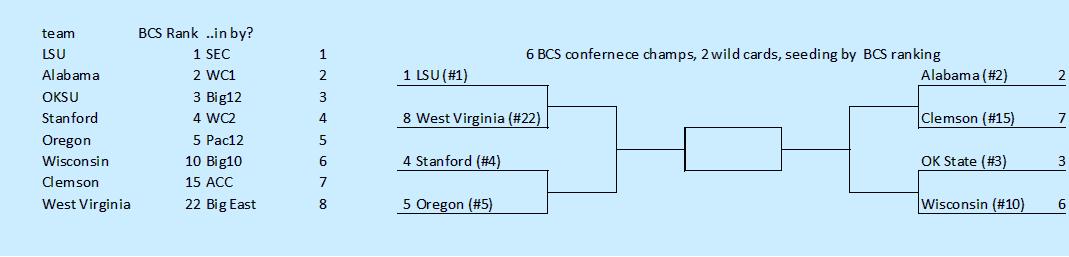
click to enlarge

That’s better, but I still don’t like that WVU and Clemson made it in. What did they do to deserve to get in? All West Virginia did was be the best in a Conference (Big East) that is a apart of the BCS because they are a good basketball conference. This goes to my point about last years NFL Playoffs. Seattle got in at 7-9, ahead of the NY Giants and the Tampa Bay Buccaneers, both of whom BEAT the Seahawks.  Simply terrible.

And what about Clemson? Why should Virginia Tech get left out because they were forced to play them in the ACC championship? They had 3 losses and were ranked 20th when they played Tech, VT was #5 and had only 1. On the other hand, is that Clemson’s fault? Is it their fault that VT choked? Same for WVU (or Seattle for that matter)?

If you find the arguments against WV and Clemson compelling, perhaps you’ll like this bracket better:

click to enlarge

Teams ranked 1-8 in the BCS are in, regardless of conference championship. But wait a minute,  3 SEC, 2 Big12, 2 Pac12 and a MWC team gets in? No Big 10 (or ACC & Big East?) Does that render those conference titles meaningless? Does that matter? What do you think the Big10, the ACC and the Big East would have to say to that?  This to me is where the rubber hits the road on why we haven’t seen a playoff in College football.  It’s not greed, or stupid-ness, it’s people with power and influence are making their case, and it is a difficult decision to make between this bracket and the above.

I personally think if there is a playoff, it should be as small as possible, I just don’t see what Kansas State, Boise State, Arkansas, Oregon or even Stanford did to deserve a shot at the title. In fact, I can make a compelling argument that LSU should be crowned as champ now, clearly they are the best in the nation.  Sure, Alabama can say, “the only team to beat us is the best team in the nation, we deserve a shot.” But conversely, LSU can say, “We beat the best team in the nation, that’s not us. We should be champs outright.” But that’s just not going to happen, so we’ll move on.

What about the controversy-du-jour; Alabama and OK State? The difference between their BCS averages is 8 one thousandths of a point. I am one who is skeptical of any type of playoff, however as a compromise, I would accept the NCAA having a special one game playoff between Oklahoma State and Alabama at a neutral location (say in St. Louis, which, according to Google Maps, is roughly equidistant between the two schools), the winner would then move on to the title game against LSU. I think that if the NCAA keeps it to these special cases (say, when the difference between 2 & 3 is less than 1 one hundredths of a point), that would be the best case scenario, in my opinion. 

What’s yours?

*The greed argument is the worst offender. What is so altruistic about a playoff? Will a playoff magically erase all money from the college football bowl season, or in college football at all? Does March Madness, or the NFL, MLB, NBA, NHL, MLS, etc. playoff systems not bring in big big BIG dollars? Ridiculous…

Friday, August 19, 2011

Two Sides of the Same Coin?

Thinking about the difference between Selfishness and Self-Interest, I found this link from Phil Miller of Market Power Blog blogging about it earlier this year. I'll start by saying I don't like this answer (nothing against the blogger who wrote it, nor am I declaring victory). He says that when a person acts with self-interest, you take not only your benefit from your action, but the benefits (or lack there of) of others (call them 'stakeholders'); and selfishness is when you don't.  But couldn't someone benefit someone else, say by transacting (trading) with them, and not be at all concerned with what happens to them? And on the other hand, can't someone inflict great harm on someone else, even when they consider others in their (I'll keep it with trading) decisions?  In other words, doesn't the old adage go that "the road to hell is paved with good intentions"?

In my humble opinion, the difference isn't with what people's intention are, it's in the connotation people attach to others' decisions - selfish being negative; self-interest being positive. The beauty of a market system is that it doesn't matter which your intentions are, you'll either go broke bending over backwards to be 'self-interested' (or it's just a marketing point, and is one of the first things to go in a downturn; or eventually the externality costs will catch up with you, either through regulation or competition.

I think Mr. Miller's intention (his self-interestedness?) is admirable, he's trying to make it OK for people to continue to act in (what's left of) our market economy. For a layman, that's fine, we can make it OK (or is it?), but this is economics dammit! We need to get it right...(don't we?)

Saturday, July 9, 2011

The Little Fishes Eat the Big Fish...

Saw this sign in this article (the print version) in the Financial Times:


Two things are interesting about this.  First, what happens when all the little fish eat the big fish? If anything demonstrates the parasitic nature of organized labor (at least as it's currently configured), this is it. 

Then there's the fallacy that the rich are "big fish" and they eat up all the little fish...go ahead Minnesota, fix your fiscal problems by taxing the top 2%, see what happens.

Thursday, July 7, 2011

Everything you 'need' at your finger tips...

...at a low cost, of course.  Dr. Don Boudreaux has this stimulating post at Cafe Hayek, and is re-posted here:

A Source of Wealth or Stagnation?

Here’s a familiar but fun scenario to ponder:

Suppose a replicator, similar to the one in Star Trek, is invented.  And what an invention it is!  Each replicator can itself be produced for only pennies.  Its inventor – either out of carelessness or magnanimity – doesn’t patent it.  Competition among replicator producers soon drives the price of replicators down to $7.99 each.

Each replicator allows its owner to produce a wide assortment not only of foods and drinks at near-zero cost, but also flowers, clothing, detergents and other cleaning materials, paints and inks, personal-hygiene products such as soap and toothpaste, contact lenses and eyeglasses, and even antibiotics and other medicines.  Within a couple of years, nearly every household in America has its own replicator.

One plausible consequence of this invention – and the material wealth it makes possible – is that Americans’ demand for leisure rises significantly.

What happens to GDP?  Would the replicator’s failure to ‘create’ lots of jobs cause it to be thought an innovation not quite on par with, say, the assembly line or the automobile?

Should we lament the invention and near-universal use of the replicator?
And my answer (in comments)
Almost instantly every American would be richer, the poor much more so. Now incomes that made it hard to make ends meet, now go much further, and they even have access to other goods they maybe did without before, like vitamins or other things that wasn’t a priority before. And they’re not only made richer in dollar terms, but also time. The time it takes to go to the store and buy items, and prepare food and drink items will also dramatically fall.

There no doubt would be impact to a wide variety of industries, the need for agriculture and most industrial goods would be eliminated (I’m assuming large industrial goods will still be needed to purchase, such as cars and the appliances that remain useful). However the people in these industries are not excluded from the benefits of the replicator, so the income they can make or the savings they have will go further. However, and at least initially there will be resistance to this new technology – almost assuredly there will be “experts” and “scientists” that will come up with studies that show that this device is harmful. However, assuming that the replicator produces items at the same quality and substance (meaning, there is NO difference between a replicated item and the original item), then over time these will subside.

One would hope that the change to the market place will be so rapid that these industries will be unable to justify a Farm or Industry subsidy. One can hope…

Investment in these areas will leave these sectors, but it will show back up in the leisure and services sector – at a higher, lower or the same amount won’t be seen until after the fact. The increase in leisure is given in the question, but there will also be an increase in services, because the replicator does have one input – the imagination and knowledge of the user. Some have better imaginations and more knowledge than others, and therefore there will be a market for “Replicator Consultant Services” that people will look to make exchanges for (either by money or barter), creating a new field.

The enormous increase in the demand for leisure will take many forms, some new will emerge that are unknown now, but what we do know is the resources used to create these Agricultural and Industrial goods before will be ‘repurposed’ by the market to meet the new demand needs, given the increase in price for these items. Fields of crops will be turned into golf courses, nature preserves, and amusement parks to meet this demand.

Again, one would hope that this tremendous increase in the wealth of all Americans would decrease the need for Government expenditure for entitlements and welfare, reducing the role of government everyone’s lives. However, there will probably be an attempt to justify their role by claiming that “these replicators need to be monitored because Americans are replicating to many pizzas and not enough broccoli,” and so on. So, one can hope…

What is certain is that the coming years will be a period of radical transition. All measures of GDP will have to be adjusted, and until everything has had a chance to emerge, it will be difficult to know how that will be measured. First, the consumption of the items that were produced are still being produced and consumed, they are just produced at a much much much lower cost than before, so the consumption portion of GDP should be at least the same, and very probably, Consumption should increase considering the increase in leisure and services. So (C) will be higher. Investment (I) very probably will be near the same or higher, but probably not as much as (C) because most of that is reallocation. And (G) could be lower, but it’s difficult to tell. My hope would be that it would shrink to the point that is not as significant a proportion as before.

So, the short answer is no, we should not lament an invention of this “replicator”, surely it makes everyone’s lives better.

Friday, April 15, 2011

A little perspective...

...on Economic Models, that some put too much faith in (HT - Garret Jones):
"Essentially, all models are wrong, but some are useful." - George E. P. Box
 Good not to forget...

Wikiquote

Tuesday, March 22, 2011

Which side are you on?


But first, it has been a LONG time since a post, my apologies to all my adoring fans. :-|

The wife and I finally watched Valkyrie last night, and I have to say we were pleasantly surprised.  What struck me most about it was that, in the movie, the failed coup that Stauffenberg had a feeling akin to the American Revolution, again, in the movie.

This got me thinking, what side would I be on? I think most people would knee jerk say that they would be on the revolt side, but how many American’s today have no interest or idea with what's going on right now? Think of this hypothetical - if 30% of the German population was disinterested in politics, and 15% of the 30 had only heard rumors and half of those people chose not to believe those rumors. That is over 20% of the population coming to a very rational decision of supporting genocide that probably wouldn’t if they knew the full truth.

This is very similar to the Clerks assessment of what Luke Skywalker really did when he blew up the Death Star the second time.  There were a lot of blue collar guys on there, construction workers, janitors, support staff – guys just trying to get a pay check.

Would you would be principled enough to join the resistance? Or smart enough to not be sucked in to mass hysteria? Or brave enough to risk your life to resist? Those are a lot of hurdles to get over when you’re living in the moment, regardless of how terrible the atrocities are.

But Nazi Germany is easy compared to the following question: What side would you have been on in the American Revolution - the Colonials or the Torys? Again, typical reactions, but think about it, are you saying what you wish or hope you would be? That question is harder to answer. 

It's the same thing I think about when I watch 20/20's "What Would You Do" segments. I assume these are designed to make you think, but isn't that cheating? Isn't it the people who do things with integrity that we celebrate? So yes, think about the answer, but be honest with yourself, and remember you're not thinking of these ex ante.

Thursday, September 16, 2010

Milton Friedman: How did Markets Survive?

I've been listening to Russ Roberts pod casts at Econ Talk, which has a pretty extensive archive section. I looked through it, and found one with Milton Friedman. This part of that podcast has had a profound impact on me:
Milton Friedman: But it's always been true that business is not a friend of a free market. I have given a lecture from time to time under the title Suicidal Impulses of the Business Community... It's in the self-interest of the business community to get government on its side. It's in the self-interest of a particular business.[...]

But the real puzzle—puzzle isn't quite the right word—the real problem here is where do you find the support for free markets? If free markets weren't so damn efficient, they could never have survived because they have so many enemies and so few friends. People think of capitalism or free markets as something that obviously is supported by business. People think that if a business party is a party in politics, it will promote free market. But that's wrong. It will be in the self-interest of individual businesses to promote a tariff here and a tariff there, to promote the use of ethanol—

Russ Roberts: Special regulations for its competitor that apply just by chance to its competitors but not to itself—

Milton Friedman: That's right.

Russ Roberts: —or that they already comply with but their competitors don't happen to comply with.
It's insights like these that attracts me to Economics, and keep me coming back for more...


Update: Here's a link to an article Friedman wrote on this subject at the Cato Institute.

Pollution Didn't Begin in 1960...

In the spirit of Dr. Boudreaux, here is a letter I sent to the Washington Post:
In his letter, “Where are conservatives' conservation efforts?” (Sept. 9th), Mr. Kennard makes in interesting connection between Hayek’s warnings about government interventions into complex market systems and human intervention into the complex environmental systems. However, he should have quit when he was ahead.
If Mr. Kennard looked back at history, he might discover that the internal combustion engine automobile was one of the single greatest advancements in pollution reduction in the 20th century (produced by in the marketplace, mind you). Before then, streets were lined with filth and the air filled with methane from horses which people used to get around.
Mr. Kennard then indicts “Conservatives” to come up with his solutions to his perceived, “problem” because they oppose “Liberal” “solutions”. My answer is to see the above.
Sincerely,
Christopher J. York
Student, George Mason University, Economics M.A.

Wednesday, June 23, 2010

US maternity leave rate is zero?

Yet another post from Dr. B: Fringe Thinking

I'm just confused on how Jackson is saying the maternity and paternity leave rate is zero, when my wife is taking 10 weeks and I am taking 2...

Actually, my wife gets 8 paid weeks, and she's taking an additional 2 unpaid. We can do this because we've planned for it and are saving accordingly.

We Kornheiser's don't produce anything...

Dr. Boudreaux shares a letter he sent to Tony Kornheiser that is in the same vein as my post yesterday.  People have a hard time with the abstract, and maybe we feel guilty if there isn't something tangible to point to when you're done with your work. My thought is any value adding work we do that gets compensated for is a good thing, be that manufacturing or producing services.

I call it "value adding work" because there are too many Keynesians out there that want to hire ditch diggers with someone to fill them.

Tuesday, June 22, 2010

If everything is made in China, are we Chinese?

Caught this on Facebook by way of My Morning Jacket, pretty good song, I'm a fan of Jim James especially. However, the italicized line caught my attention:
The Roots - Dear God 2.0:
They said he's busy hold the line please
Call me crazy, I thought maybe he could mind read
Who does the blind lead?
Show me a sign please
If everything is made in China, are we Chinese?
Aside from the line being a non sequitur to the rest of the verse, the premise is also way off.  Of course we're not Chinese because we buy Chinese stuff, the point he's making with a seemingly throw away line is that America doesn't produce anything.  Instead of going into a long, complicated rant about trade (quick version - it's good for everyone!), I'm simply going to point out that it is ironic that his problem is that we don't produce anything, all while he's making music.  It's intangible, yes, but he makes a living off of it, I'm not sure how well a living, but one none the less. I wonder if anyone in China will buy this record, or if the CD's their music is recorded on is made in China...

I'll apply a common example used when discussing trade to explain further.  If I like movies, and I go out to them all the time, am I Hollywood...inian, even though I'm from Virginia?  Or vice-versa, if Smokers in Hollywood smoke tobacco from Virginia, does that make them Virginian?  Of course not.

Not a perfect game...

This is a little over due, probably because I found my position wasn't as controversial as I had thought:

Russ Roberts at Cafe Hayek has a post about Detroit Tigers pitcher, Armando Galarraga, start on June 2nd where he pitched good enough to earn a perfect game. Unfortunately for him, he didn't because of, as umpire Jim Joyce has admitted, a blown call.  That, in and of itself, is why he didn't, and I'm glad to see that Bud Selig didn't cave to pressure to 'make it right'.

The way I've always heard it, a perfect game is facing the minimum - 27 up, 27 down.  No runs, no hits, no walks, no errors.  Not one batter reached base safely.  That didn't happen in that game and that's why it wasn't a perfect game.

I think the natural tendency to want to 'make this right' is because the belief is that Galarraga deserved a perfect game. He pitched a heck of a game, before and after the bad call by Joyce, but that doesn't guarantee anything, not even a win (see the rest of Dr. Roberts' post for the story of Harvey Haddix). In fact, it doesn't make sense that pitchers are credited with Wins and Losses anyway, since you can pitch terribly and give up 8 runs and still win, and pitch great and get a loss or even a no decision.

The good thing that came out of this was seeing Galarraga handle himself. He is a classy, stand-up guy, and should be a role model for good sportsmanship now and in the future.

Monday, June 7, 2010

Bastiat & The Oil Spill

Russ Roberts has a post about the oil spill, asks as question that is similar to my earlier post about Bastiat.

Friday, May 28, 2010

Did they even read it?

The movie 'Preadators' opens this July, it's the 4th (?) installment of the franchise. This is the movie poster for it:


Image - moviefone.com (click to enlarge)
 
The tagline caught my attention, it says:

"They are the most dangerous killers on the planet.
But this is not our planet."
I'm no english major, but this doesn't appear correct. Shouldn't it be:
"They are the most dangerous killers on THEIR/OUR planet.
But this is not THEIR/OUR planet."
or, even better:
"They are the most dangerous killers on EARTH.
But this is not EARTH."
If I'm right, how does something like this get passed and approved? Does it speak to the quality of the movie itself? Only time will tell...

Wednesday, May 26, 2010

A Rose by any Other Name, Would Smell Like...???

The venue formally known as Nissan Pavillion will now be known as Jiffy Lube Live.  I wonder, did Nissan pull out, or did they get out bid by Jiffy Lube? Or, was the offer by Jiffy Lube a standing offer, and the economy pushed them to accept the offer?  I also find it interesting that just the name alone makes the venue seem cheap, even with out going there.


image from: http://www.jiffylube.com/

The venue is still the same, it just has different logos advertisements. But why is it that we think Nissan is OK, but Jiffy Lube isn’t? How about the Snagajob.com Pavilion just outside of Ricmond? I don’t think I would even visit the website, Snagajob.com in the first place, let alone go to their Pavilion. OK, maybe if I had front row tickets to Pearl Jam…

But then again, I wonder about other business sponsorships that are taken seriously, like Michelin Stars. These are ratings given by the tire manufacturer, rating restaurants all over the globe. Apparently, if you have just one star, it means you’re a very good restaurant, and you can get up to three, and it’s taken very seriously. But, why or how is a tire company any kind of expert in the culinary world? (Maybe this has something to do with it?)

Companies also try to pass off an inferior product, and use its good name to do so. Toyota did this, I believe, with their Camry line of cars (if not their entire line). About 2 years ago, I was in the market for a car, and test drove the Camry, partly because I knew of Camry, and thought they were very good cars. When I test drove the ‘08 model however, I thought it was a piece of junk. It was underpowered, small, and felt cheap – like it was made of plastic. I ended up buying a Honda Accord instead. It has since turned out that my feelings were justified, with the recent gas pedal issues Toyota has been having. I also love my Accord.

The point is that brand names have value for a company, and companies use that value in different ways. Nissan meant quality, and it transferred to the venue (or vice versa); while Jiffy Lube doesn’t, or hasn’t yet. Michelin has worked very hard to earn the respect it garners from their Michelin Guides (interestingly because of how difficult it is to earn even one star, at least in part). Lastly, it seems Toyota relied too heavily on their good name, and now they’re paying for it.

Monday, May 24, 2010

Broken Healthcare Fallacy...

Didn't blog the last couple of weeks, had a paper and a take home exam due.  Apologies (to the NO people who are reading...)

I randomly listened to Adam Bold's Mutual Fund Show (an investment advice show sponsored by his company, The Mutual Fund Store, of which he is the founder) from last Saturday (5/15/10). In it, he had a caller who was a banker that asked what he thought the impact of the recent passage of the Obama Healthcare Plan would be on the economy. Mr. Bold seemed to think the impact would be positive.


I won’t argue with him about whether he’s right or wrong, it would be tough to tell either way. However, I will take issue with his justification why he thinks this. He said that, implying that even if the HC plan were bad for the economy, it would be OK because of all the jobs they would be creating in the healthcare industry. I’m pretty sure this is a pretty cut and dry case of Frédéric Bastiat’s Broken Window Fallacy.

In it, Bastiat showed that it is incorrect to look at broken windows as good for the economy, because it “creates” jobs for the glaziers (window repairmen). On the whole, yes the glazier is up a job, but the shoemaker that has his window broken is down what he would have bought with that money had the window not been broken. (The name of the piece is That Which is Seen, and That Which is Not Seen )

In this case, the broken healthcare and then the supposed influx to fix it is what is seen. The healthcare we had and the output that would be otherwise used is what is not seen.

Sunday, May 2, 2010

Why did they attack us again?

An exclusive interview from WTOP with a former Al Qaeda insider says that Osama Bin Laden had no idea that the US would retaliate the way that they did. Quote:
"What happened after the 11th of September was beyond their imagination, " says Benotman, who adds that al-Qaida thought the U.S. was a "paper tiger."
He continued...
Benotman attributes al-Qaida's overconfident attitude to the United States' response to al-Qaida attacks on its in embassies in Nairobi, Kenya and Dar es Salaam, Tanzania in 1998.
Zawahiri, according to Benotman, expected only a missile attack.
"When they attacked the embassies in East Africa, they estimated the U.S. launched 75 cruise missiles and eight people got killed. So they said this time, maybe they will launch 200 and they laughed about this."
This revelation flies in the face of the common perception that Western globalization or US foreign policy is why we were attacked on 9/11, or that diplomacy will resolve our issue with Islamic extremeism.  In fact, non-engagement escalate attacks far beyond what would otherwise be. I'm not saying that the global economic environment or American intervention doesn't play a role.  But given this, it's not a good argument for not confronting treats as they arise.

Thursday, April 22, 2010

The market would do that anyway...if you let it.

US Treasury Secretary Timothy Geithner vowed Thursday to put failing banks that take too much risk "out of existence" in order to avoid bailing out firms deemed "too big to fail" at taxpayers' expense.

"Our view is that we need to make sure that you're limiting how big they can get and how risky that they can get," Geithner told ABC News as the US Congress pursues negotiations on a sweeping financial reform bill.

"But if, in the future, if they mess up and they take themselves to the edge of the cliff again, then we want to make sure we can put them out of existence, dismember them, break them up safely without the American taxpayer having to bail them out again."
(link)

Government tells banks, we will bail you out if you're too risky, what do the banks do? Surprise surprise, they're more risky.  Now the Federal Governement is going to do what the market would do anyway...why?  To control WHICH banks fail!

This is called crony capitalism. Couple this with what's going on with Goldman Sachs right now, and it's clear.

Tuesday, April 20, 2010

The Volcano

The Icelandic Volcano is putting so much ash into the air that it closed UK airports for 6 days (necessarily?). What will we see first, a report about how this type of pollution is OK, because it's "natural", or a report showing the environmental impact of the eruption?

A little science...

UPDATE: Looks like both at the same time...